
Knob-and-Tube Wiring Ottawa: Risks, Insurance & Replacement Cost
Thousands of Ottawa homes built before the 1950s still have knob and tube wiring running through their walls and attics. When it was installed, it was the standard — and it was safe for the electrical loads of that era. But a century later, this wiring is one of the most serious fire and safety hazards in residential homes. Knob and tube wiring cannot handle modern electrical demands, has no ground wire, deteriorates with age, and becomes extremely dangerous when covered by insulation. If your Ottawa home has it, this guide covers everything you need to know: how to identify it, the real fire risks, what it means for your home insurance, and what full replacement costs in 2026.
⚠️ Quick Summary — Knob and Tube Wiring
Knob and tube wiring is a fire hazard in modern homes. It has no ground wire, no capacity for today’s electrical loads, and becomes extremely dangerous when touching insulation. Most insurers will not cover homes with active K&T or charge significant premiums. Full replacement costs $8,000–$25,000+ depending on home size and accessibility.
If you are buying, selling, or insuring an Ottawa home — K&T wiring must be addressed.
What Is Knob and Tube Wiring?
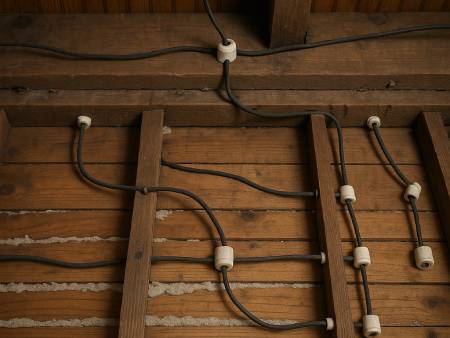
Knob and tube wiring (K&T) was the standard residential wiring method in North America from the 1880s through the 1940s. It uses individual hot and neutral wires run separately through the house, supported by ceramic “knobs” screwed to framing and passed through ceramic “tubes” where wires cross structural members. The wires are insulated with a rubberized cloth sheathing and are designed to dissipate heat into the surrounding air — which is why they were always installed with air space around them.
In Ottawa, knob and tube wiring is most commonly found in homes built before 1950, particularly in neighbourhoods like the Glebe, Old Ottawa South, Centretown, Westboro, Hintonburg, New Edinburgh, and Sandy Hill. Many of these heritage homes still have some or all original K&T wiring in place — often hidden behind finished walls and ceilings where it has been forgotten for decades.
Why Knob and Tube Wiring Is Dangerous in 2026
K&T wiring was adequate for homes with a few lights and a radio. It was never designed for air conditioners, microwaves, computers, EV chargers, and dozens of devices drawing power simultaneously. Here are the specific dangers:
🔥 Fire from insulation contact. This is the number one killer. Knob and tube wiring must have air circulation to cool itself. When blown-in or batt insulation is installed over K&T — as has been done in thousands of Ottawa attics for energy efficiency — the wires overheat and can ignite the insulation. This is a code violation under the Ontario Electrical Safety Code and one of the leading causes of house fires in older homes.
⚡ No ground wire. K&T wiring has only two conductors — hot and neutral. There is no ground wire. This means three-prong outlets cannot be properly grounded, shock hazards are increased, and surge protectors cannot function. Any fault current has no safe path to ground.
🧵 Deteriorating insulation. The original rubberized cloth insulation becomes brittle after 80–100+ years. It cracks, flakes, and falls off — leaving bare copper wire exposed inside walls, in attics, and in basements. Bare live wire touching wood framing or other materials creates a direct fire and shock hazard.
🔌 Circuit overloading. K&T circuits were designed for 15-amp loads serving a few lights. Modern rooms draw far more power than these circuits can safely handle. Overloaded K&T wiring heats up, and with degraded insulation, the risk of ignition multiplies. See our page on circuit overload repair.
🔨 Amateur modifications. Over a century, K&T systems have often been spliced, extended, and modified by unqualified people. Improper connections made with electrical tape instead of proper junction boxes are extremely common — and extremely dangerous. Browse our junction box repair and backstabbed wire repair services.
Knob and Tube Wiring & Home Insurance in Ottawa
Insurance is often the trigger that forces homeowners to address knob and tube wiring. Here is the reality Ottawa homeowners face:
🚫
Refused Coverage
Many major insurers will not write new policies for homes with active K&T wiring. This can prevent home sales.
💰
Higher Premiums
Insurers that do accept K&T often charge 15–25% higher premiums and may impose conditions like mandatory electrical inspections.
📋
Claims Denied
If a fire starts from K&T wiring and you did not disclose it or address known issues, your insurer can deny the claim entirely.
✅
After Replacement
Once K&T is fully replaced, insurers offer standard rates. Many homeowners recover the premium savings within 10–15 years.
A pre-purchase electrical safety inspection identifies K&T and gives you negotiating power — or protects you from buying a hidden problem. Read our safety inspection guide for full details.
Worried About Knob and Tube Wiring?
Free assessment. Licensed Ottawa electricians. Clear replacement quotes.
📞 (613) 319-8430
Knob and Tube Wiring Replacement Cost in Ottawa (2026)
Replacing knob and tube wiring means running entirely new NMD90 copper cable throughout your home, installing a modern grounded electrical panel, and bringing every circuit up to current Ontario code. Here is what it costs:
These costs include the electrical work, ESA permit, and inspection. Wall and ceiling patching/painting after the rewire is typically handled by a separate drywall contractor. For detailed pricing on the panel component, see our panel upgrade cost guide. Our wiring and rewiring services page covers our full process, and our post on rewiring older Ottawa homes provides additional detail on what to expect during the project.
How to Identify Knob and Tube Wiring in Your Home
You can often spot knob and tube wiring without opening walls. Check these accessible areas:
🔍 Attic: Look for white ceramic knobs (mushroom-shaped, screwed to joists) and ceramic tubes (cylinders passing through framing). Wires will be individual conductors with cloth-wrapped insulation, not the modern plastic-sheathed cable you see in newer homes.
🔍 Basement: Look along joists and beams for the same ceramic knobs and cloth-wrapped wires running individually rather than bundled in a cable sheath.
🔍 Outlets: Two-prong outlets with no ground slot are a strong indicator. Removing an outlet cover plate (with the circuit off) reveals the wiring type — K&T wires are individual conductors, not the bundled NMD cable used since the 1950s.
🔍 Home age: If your Ottawa home was built before 1950, assume K&T is present until proven otherwise. Many homes have a mix — some circuits rewired over the decades, others still original. Only a thorough electrical inspection can identify every K&T circuit. See our guide on old outlet safety and our ungrounded outlet repair services.
🚨 Critical Insulation Warning: If you have knob and tube wiring in your attic and blown-in insulation has been added over it, this is an immediate fire hazard and a code violation. The insulation traps heat around wires that were designed to cool in open air. Do not add insulation over K&T wiring. If insulation is already in contact with K&T, have a licensed electrician assess the situation urgently. Call our emergency line if you discover bare wire or scorching.
What the Replacement Process Looks Like
Replacing knob and tube wiring is a significant project, but a skilled electrician minimises disruption. Here is the typical process:
Assessment and mapping. The electrician traces every K&T circuit, identifies what has been modified over the years, checks for insulation contact, and produces a scope of work and fixed-price quote.
Panel upgrade. A new 200-amp electrical panel is installed to support modern circuit capacity, AFCI/GFCI protection, and proper grounding.
New wiring throughout. Modern NMD90 cable is run through the home — via attic, basement, and strategic access points to minimise wall openings. New circuits, outlets, and switches are installed.
K&T disconnection. All old knob and tube wiring is disconnected from the panel and rendered dead. In many cases the old wire is left in place (it is harmless once disconnected) rather than tearing open every wall to physically remove it.
ESA inspection and certificate. The Electrical Safety Authority inspects all work and issues a certificate of inspection. This document is what your insurer needs to confirm K&T has been replaced and to adjust your premiums accordingly.
A full rewire of an average Ottawa home takes 5–10 working days. Explore our knob-and-tube wiring repair services, our old wiring replacement page, and our page on aluminum wiring repair — another legacy wiring type found in Ottawa homes.
Frequently Asked Questions
Is knob and tube wiring illegal in Ottawa?
Existing knob and tube wiring is not illegal — it is “grandfathered” under the code that was in effect when installed. However, it becomes a code violation if insulation covers it, if it has been improperly modified, or if it is overloaded beyond its rated capacity. You cannot extend or add to existing K&T — any new work must use modern wiring.
How much does it cost to replace knob and tube wiring in Ottawa?
Full knob and tube wiring replacement costs $8,000–$25,000+ depending on home size and accessibility. The average Ottawa home (1,200–2,000 sq ft) runs $12,000–$20,000 including the panel upgrade, complete rewiring, and ESA inspection.
Can I insulate my attic if I have knob and tube wiring?
No — not until the K&T is replaced. Insulation trapping heat around K&T wires is a leading cause of house fires in older Ottawa homes and is a code violation. Replace the K&T first, then insulate freely. This is one of the strongest reasons to invest in replacement now.
Will my home insurance cover knob and tube wiring?
Some insurers cover homes with K&T at higher premiums, often with conditions. Many major carriers refuse coverage entirely. After full replacement, you receive standard rates. Always disclose K&T to your insurer — failure to do so can void your entire policy.
Can I do a partial replacement?
Yes. Some homeowners replace K&T one floor or one area at a time for budget reasons. However, any remaining K&T must still be disclosed to your insurer and may still affect premiums. Full replacement is strongly recommended and provides the best return on investment.
How long does a full knob and tube replacement take?
A complete rewire of an average Ottawa home takes 5–10 working days for the electrical work. You can typically remain in the home during the project, though power to specific areas will be off during active work on those circuits.
Does replacing knob and tube wiring increase home value?
Absolutely. K&T wiring is a red flag for every buyer and every home inspector. Full replacement removes a major negotiation issue, makes your home insurable at standard rates, and allows attic insulation — improving energy efficiency and resale value simultaneously.
I’m buying an Ottawa home with knob and tube — what should I do?
Get an electrical safety inspection before closing. Use the replacement cost to negotiate the purchase price. Verify you can obtain insurance. Budget for replacement within the first year of ownership.
Is knob and tube wiring the same as aluminum wiring?
No. They are different systems from different eras. K&T (pre-1950s) uses copper wire on ceramic insulators with no ground. Aluminum wiring (1960s–1970s) uses aluminum conductors in standard cable — it has different risks (expansion/contraction at connections). Both require professional attention.
Does Electricians Ottawa replace knob and tube wiring?
Yes. We specialise in complete knob and tube wiring replacement for Ottawa heritage homes. From initial assessment through ESA certification, we handle the entire project. Call (613) 319-8430 for a free assessment and fixed-price quote.
Protect Your Heritage Home
Knob & tube wiring replacement. Licensed Ottawa electricians. ESA certified.
Serving Ottawa, Kanata, Orleans, Barrhaven, Nepean & all surrounding areas.
📞 (613) 319-8430